


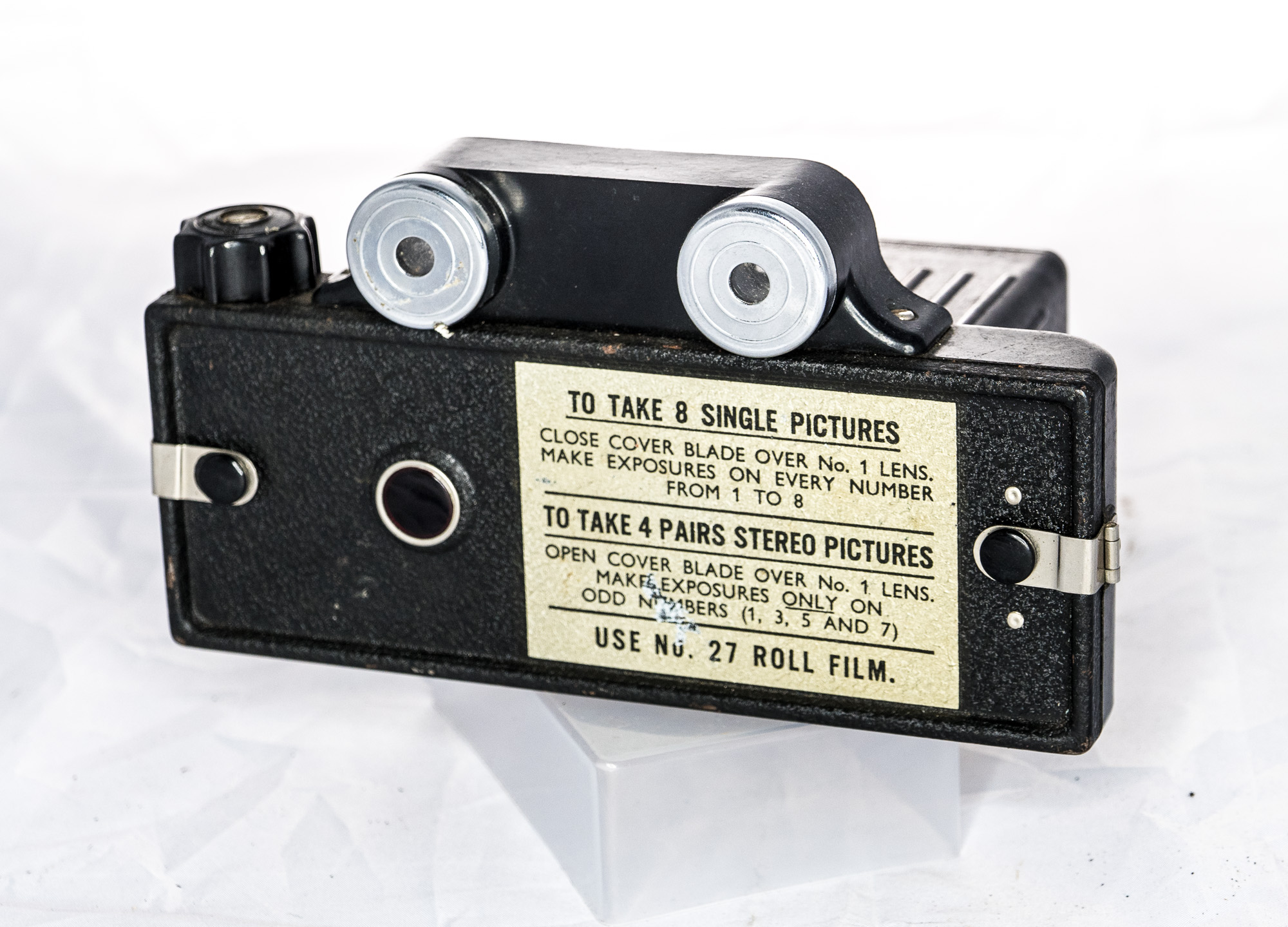


This is a British stereo camera from the fifties. It takes stereo pairs on 127 film.
The “Three-D” from Coronet is a stereo camera for pairs of photos on 127 film. Early versions had a ribbed bakelite case, although this was supplanted by the smooth case shown here. Later models had a speckled bakelite body. The camera employs fixed-focus lenses with a single shutter speed, and the shutter release is located on the right side of the camera, towards the front of the body.
By blocking one lens with a built-in internal metal cover, the camera can take 8 single (non-stereo) images per roll.
This is a British stereo camera from the fifties. It takes stereo pairs on 127 film. I particularly like the binocular finders.
You’ll see other variations of this camera with different finder arrangements, and you might notice the illustration on the cardboard packaging shows a single direct-vision finder. The earlier cameras also had a little reflex finder with the front window being where the round ‘coronet’ moulding is on this camera.
The back of the camera has brief instructions on using the camera to take single exposures, but I can’t think why you’d want to, can you?


