
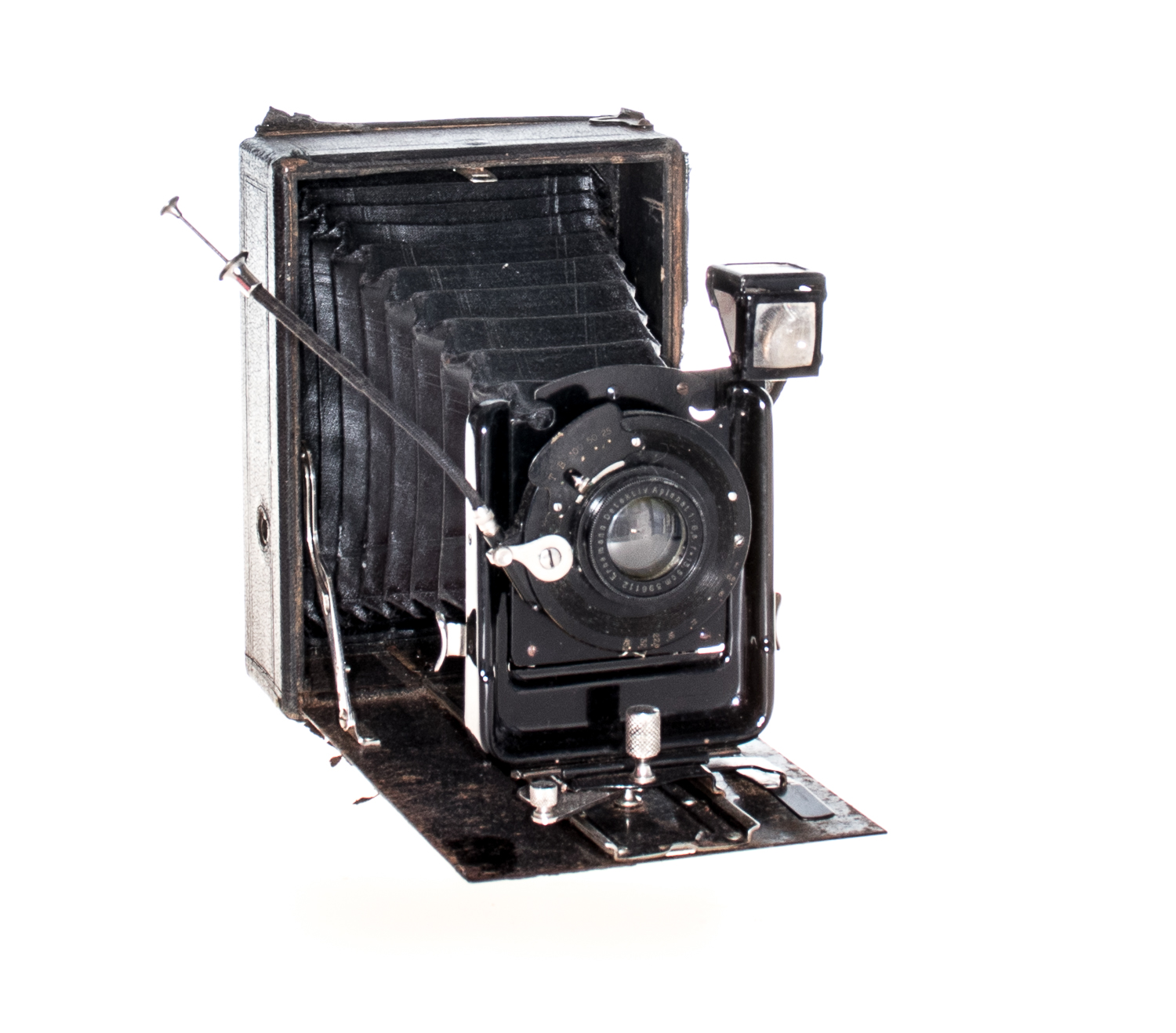
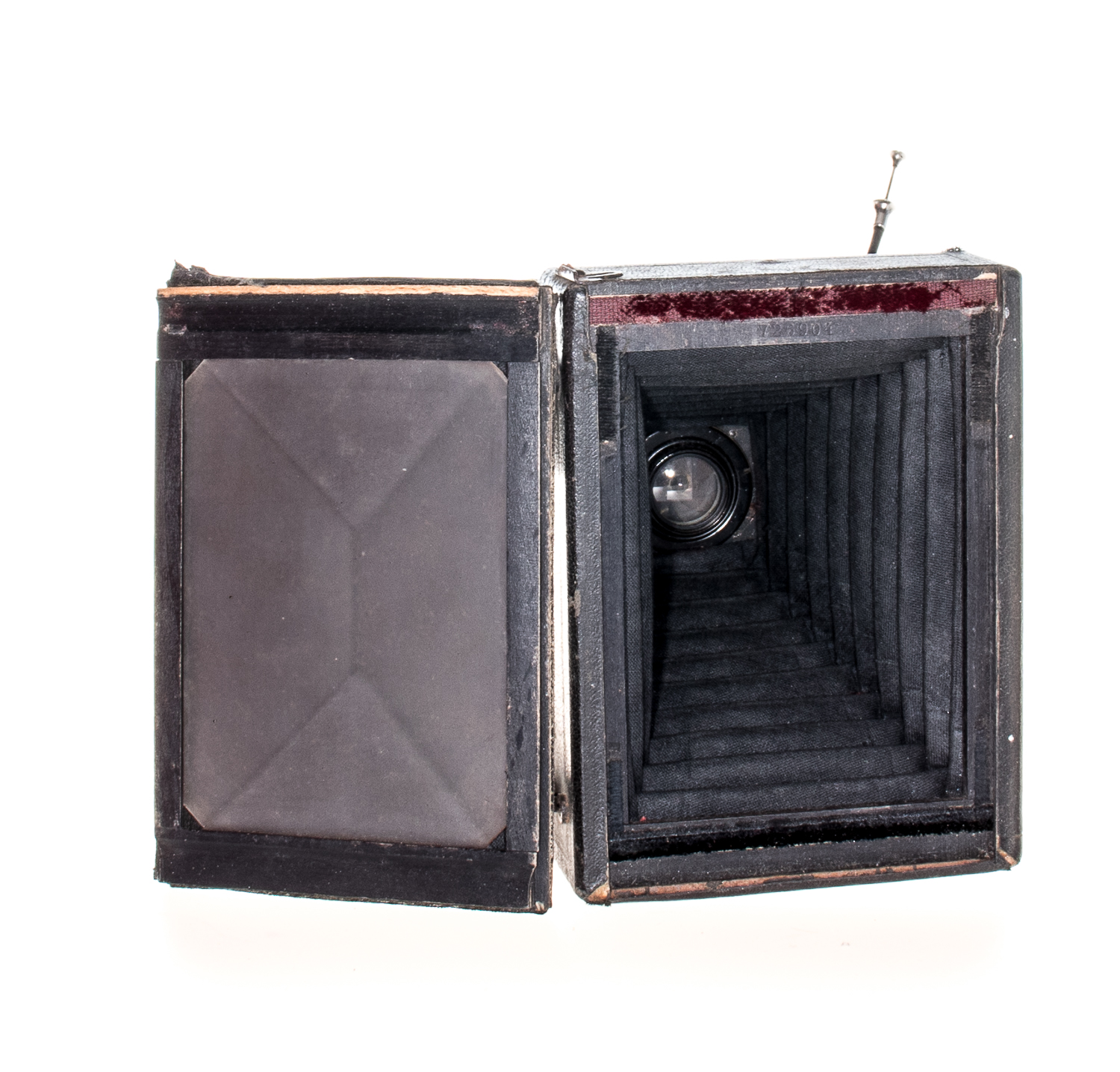
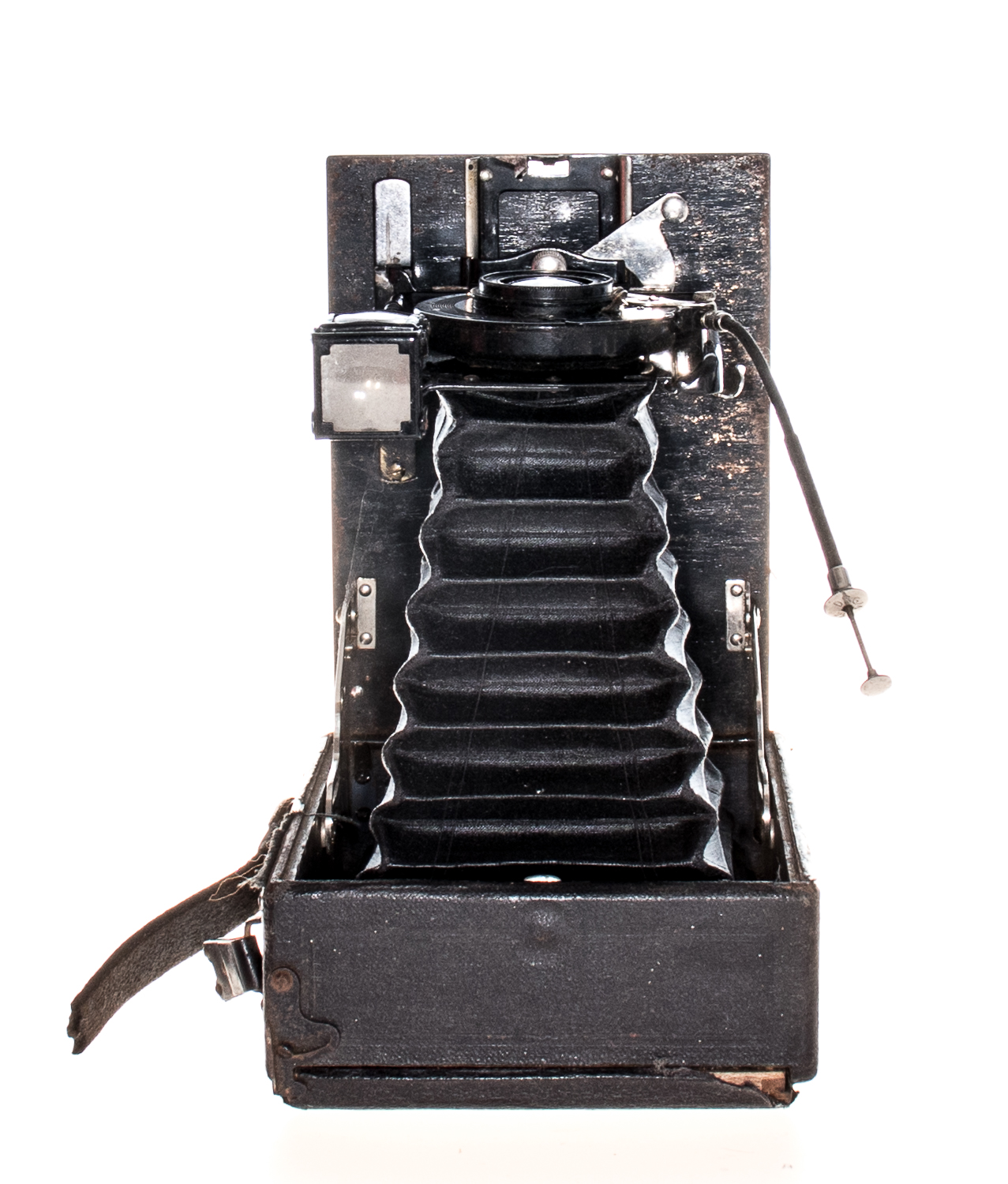
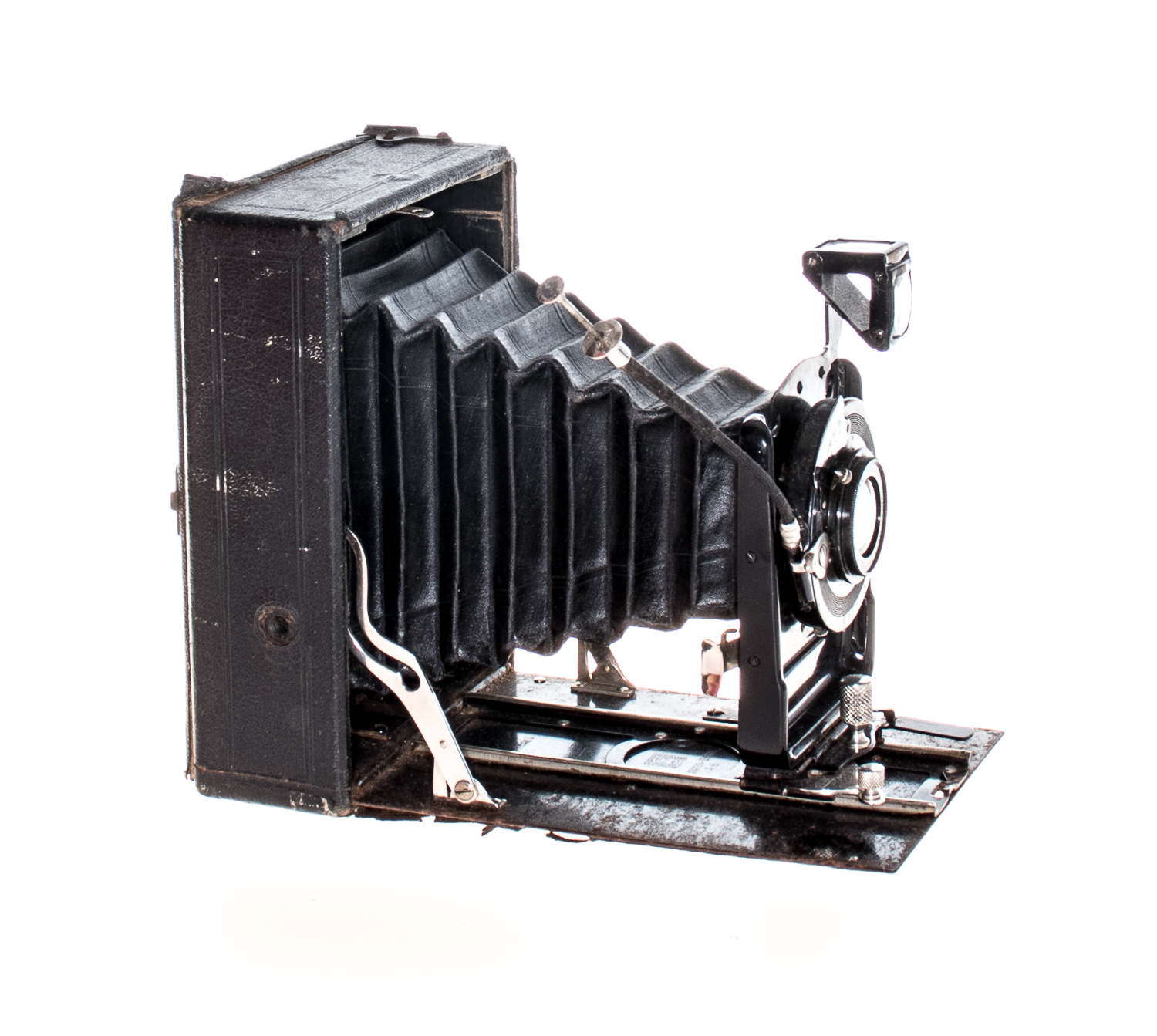
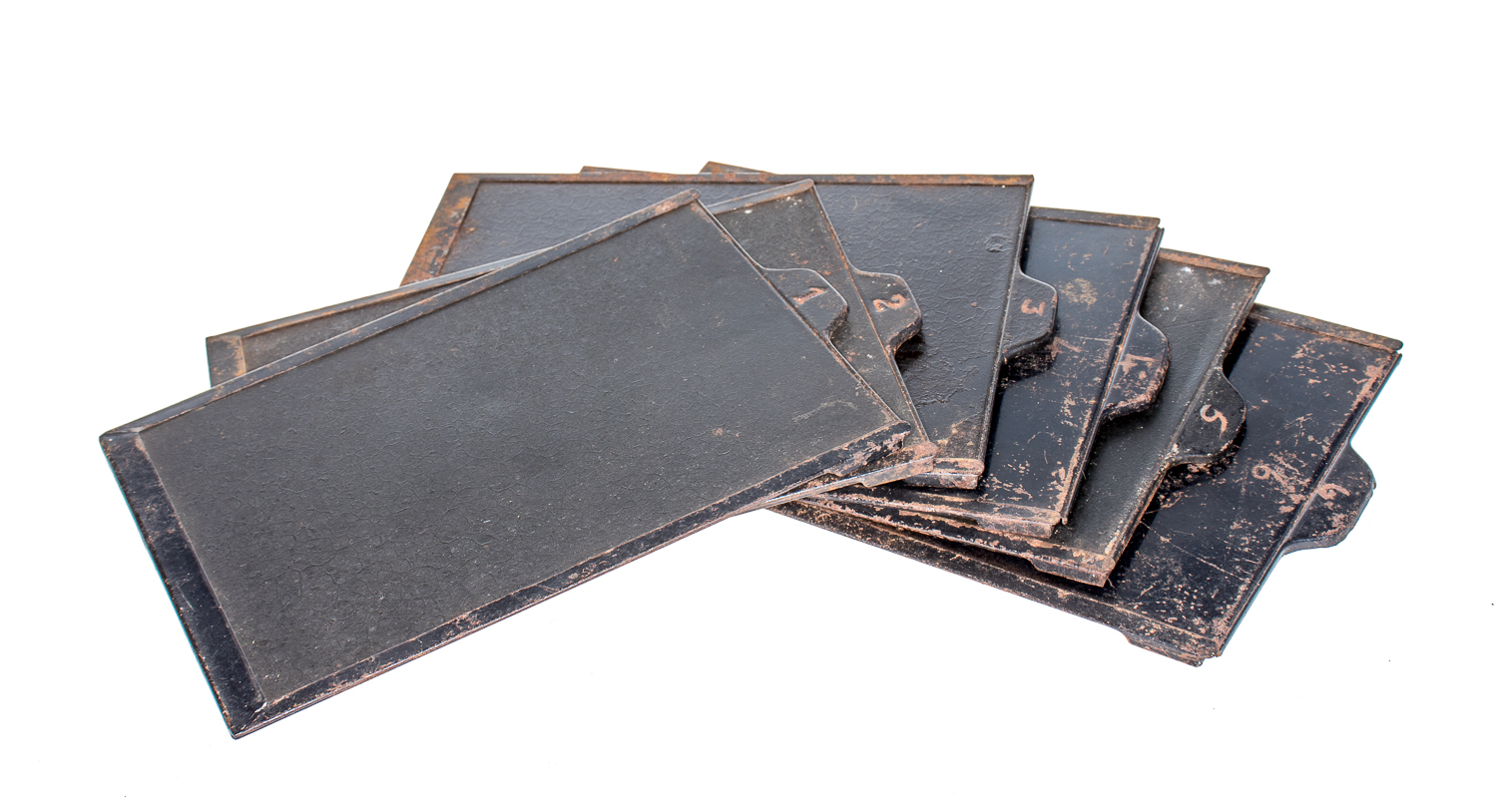
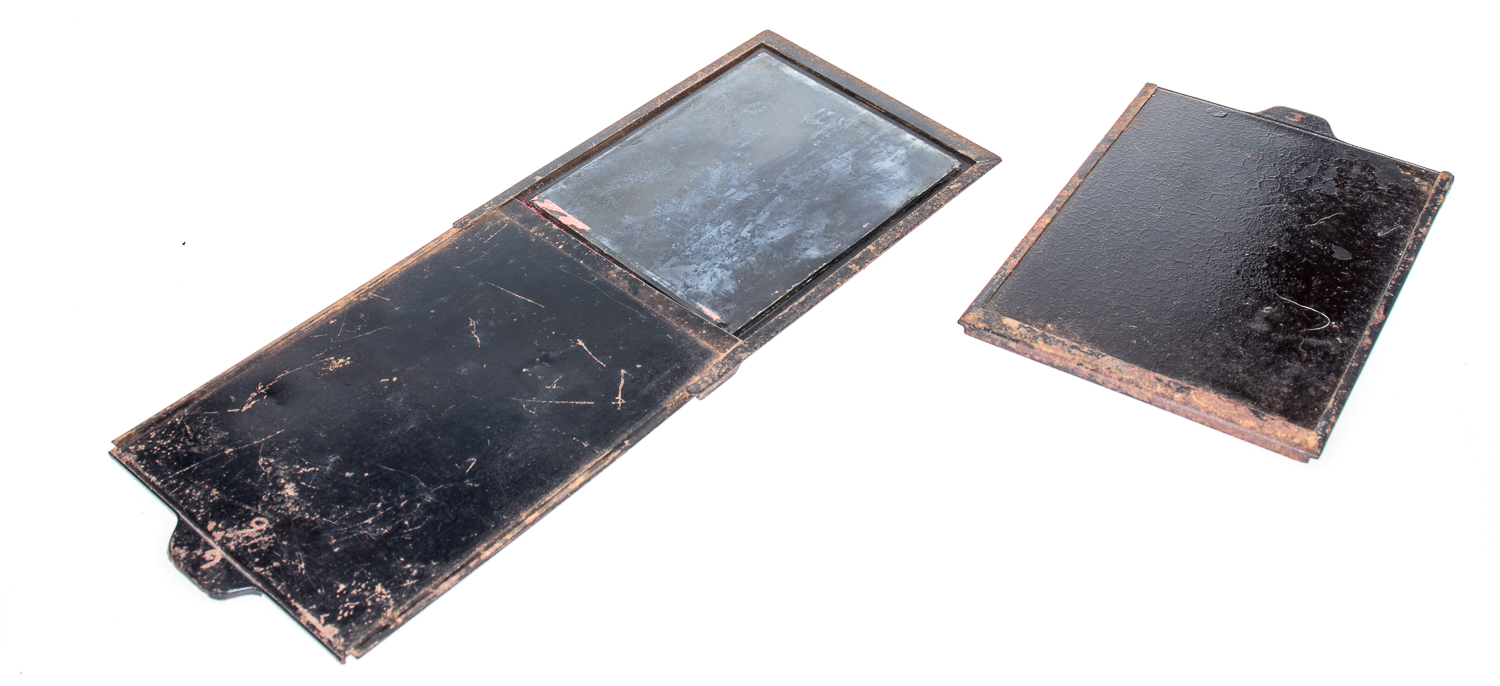
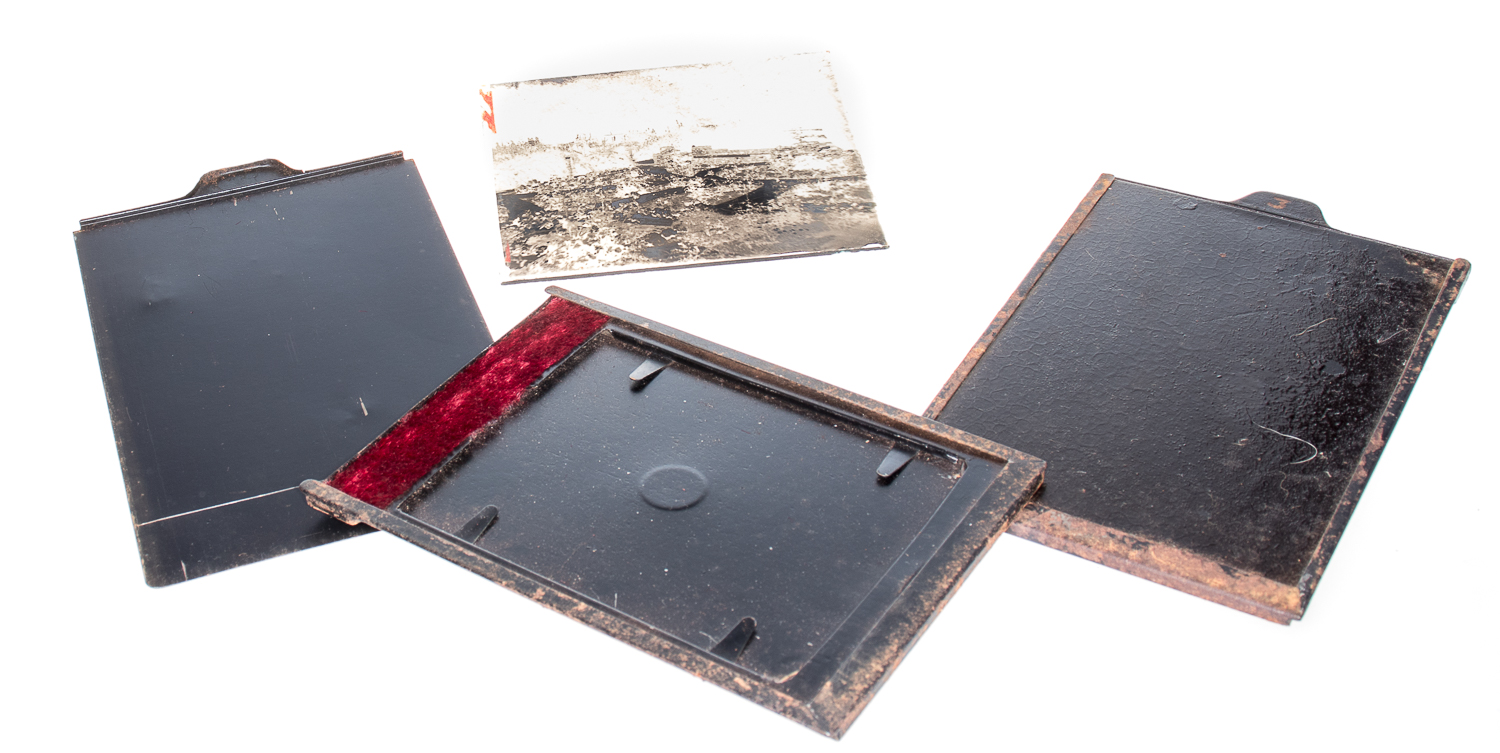
With 6 cassettes and 1 exposed plate
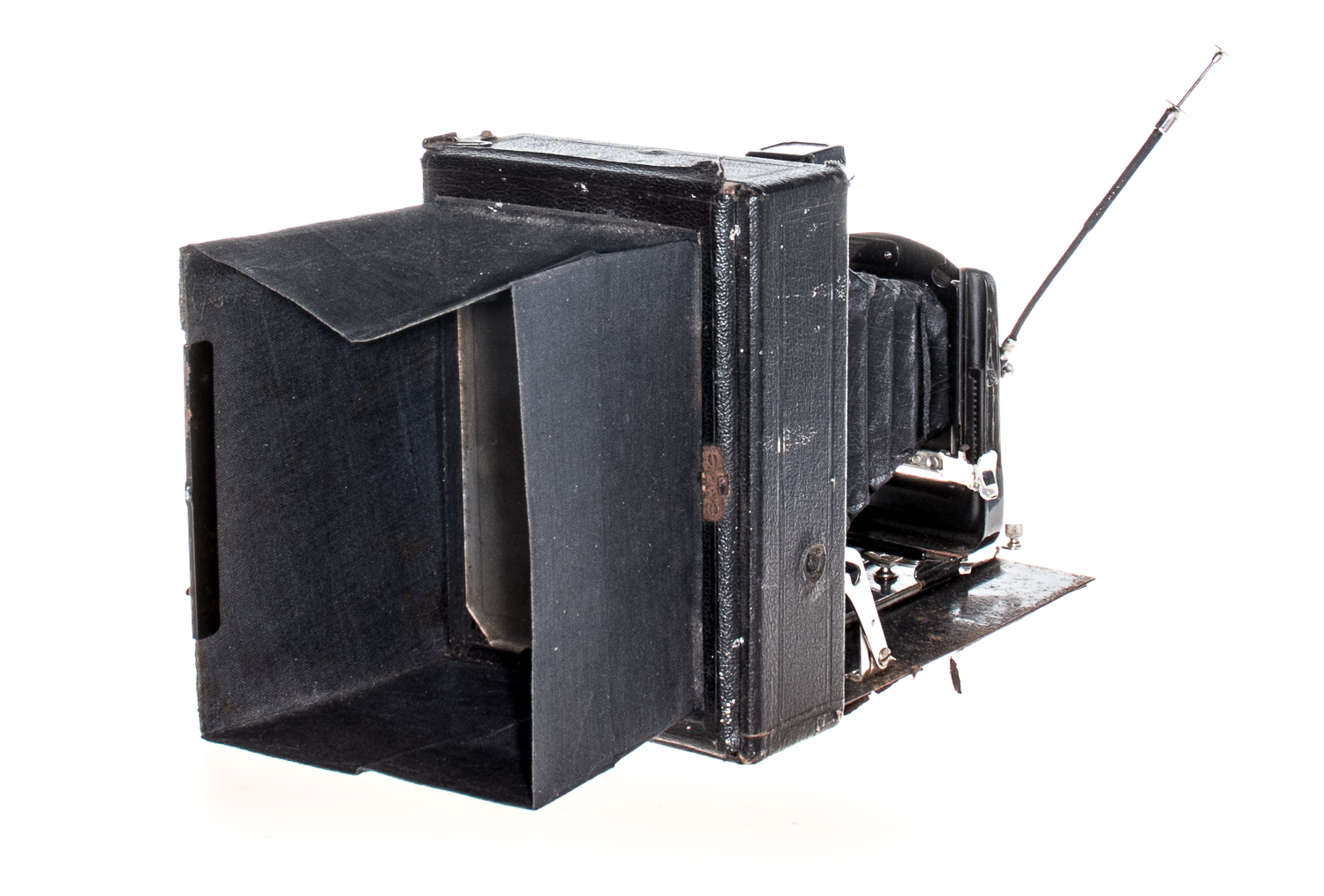
Folding plate camera with detective Aplanat 1=6.8 f=80mm lens,
With six cassettes and one exposed plate
Folding plate camera with detective Aplanat 1=6.8 f=80mm lens,
Ernemann-Werke A-6
MADE: 1920-1925 in Germany
MAKER: Ernemann Werke
A-6 plate camera by Ernemann Werke.
DETAILS
CATEGORY: Photographic Technology
MATERIALS: cardboard, glass, leather and metal (unknown)
MEASUREMENTS: overall (upright, closed): 121 mm x 91 mm x 48 mm,
TYPE: camera
Science Museum Group. Ernemann A-6 Camera. Y1966.28.60Science Museum Group Collection Online. Accessed September 16, 2021. https://collection.sciencemuseumgroup.org.uk/objects/co8404552/ernemann-a-6-camera-camera.
Heinrich Ernemann (1850–1928) began his entrepreneurship with a Dresden shop for linen goods, trimmings and stockings. In 1889, he and his partner, Mr. Matthias, founded Dresdner Photographische Apparate-Fabrik Ernemann & Matthias. Since 1890, they powered their factory with steam engines, and one year later, in 1891, Matthias left the company.
Ernemann was self-educated about photography and talented enough to get into that business. His company’s first products were wooden cameras for professional photographers. Until 1896, the company’s production was limited mainly to the wooden parts; other parts had to be bought from suppliers.
Ernemann wanted to gain complete control of on-camera production, adding four new departments for camera parts production. The booming camera industry in Dresden led to a period of overproduction. Still, Heinrich Ernemann knew how to get through the crisis: he transformed his factory into a stock market company, the Heinrich Ernemann, Aktiengesellschaft für Cameraproduktion in Dresden, founded in 1899.
The new corporation produced cameras and movie projectors in Dresden and Görlitz. It took over the camera maker Ernst Herbst & Firl and continued its Globus camera series. From 1901 to 1907, it was the exclusive maker of Stöckig’s Union cameras. Later it used that brand itself.
In 1903, Ernemann began producing small cine cameras for amateurs. In 1904, Heinrich called his son, Alexander Ernemann, back from the U.S., where he had gone five years earlier to get international experience and become the company’s technical director; with him, cinematographic activities were driven further. The first cinema projector didn’t work well, but that failure resulted in the steel projector “Imperator” construction in 1909.
Alexander Ernemann also introduced more modern American ways of production and reward. This led to a strike in 1905 but put Ernemann into a better position when the photography industry suffered overproduction in 1908, forcing the company’s competition to merge into ICA in 1909.
In 1907, Ernemann introduced its first SLR camera, and one year later, in 1908, it started making its lenses. Until then, it had purchased lenses from Carl Zeiss and Goerz. Before the First World War, Ernemann employed Johan Steenbergen, who later founded Ihagee, also in Dresden.
During the war, Ernemann partially switched to producing military products like its machine-gun camera and found many new customers for its “civil” vest pocket cameras among the soldiers. In 1920, Ernemann formed a company for its movie projectors and the steel producer Krupp, Ernemann-Krupp Kinoapparate. The successor of this projector company still exists today (see links below).
In 1923, the camera division moved to its new factory building in Dresden-Striesen. The building’s central tower, designed by Emil Högg and Richard Müller, has stood in Dresden-Striesen since 1923. [1] It is still known today as the Ernemann Tower. This tower became the symbol of VEB Pentacon and has also been called the Pentacon tower.
The post-WWI times of the great German inflation until 1923 were good for Ernemann since inflation allowed low product export prices. In 1924, the company had to rationalise production, despite which Ludwig Bertele developed the “Ernostar 1:2” asymmetric lens with six elements for Ernemann. The company introduced the Er-Nox camera for 6×4.5 exposures for this fast lens in 1924. In 1925 a 6×9 format version followed, and the cameras were renamed Ermanox. The Ernostar lens could be improved. It was a high-speed and large f/1.8 85mm lens, allowing photography in dimly-lit theatres and the like, using only available light. Finally, a reflex version of the Ermanox was released in 1926. Other famous cameras from Ernemann include the Bob folding series, the Heag line of cameras, and several sophisticated folding cameras.
In 1926, Ernemann merged with ICA, also in Dresden, Goerz in Berlin and Contessa-Nettel in Stuttgart to become Zeiss Ikon. By this time, Ernemann had acquired 213 patents.


